I’d like to introduce one of my favorite flowering plants—Streptocarpella ‘Concord Blue’, a reliable, long-blooming shade plant that holds both horticultural and personal meaning for me.
Streptocarpella ‘Concord Blue’: A Low-Maintenance, Ever-Blooming Shade Plant to Love
This plant is special not only because of its ease of growth and continuous flowering, but because it reminds me of a dear friend I miss. One of the wonderful things about gardening is how plants connect us to memories of people and places. A sea of azure irises might recall your childhood home, bright red poppies may bring thoughts of a grandmother’s garden, or hostas might remind you of a friend in whose garden you shared work, laughter, and more than a few secrets. Plants have a way of keeping those memories alive.
Streptocarpella: A Grower's Favorite
Streptocarpella was a favorite of my friend Bill Palmer, a dedicated and knowledgeable plantsman and grower. I had the privilege of working for him and later alongside him for many years at a large independent garden center/grower in Maryland. Even while bravely battling non-alcoholic liver disease, Bill rarely missed a day of work. When I see this plant, I think of his quiet strength—dependable, resilient, and generous, much like Streptocarpella itself.
Bill didn’t need to wax philosophical about plants. He simply recognized a good one when he saw it and believed we should grow more of them, even if they weren’t yet familiar to most gardeners. You certainly won't be disappointed if you take his advice and grow this plant for yourself!
Why Isn’t Streptocarpella More Popular?
I’ve often wondered why Streptocarpella ‘Concord Blue’ never reached the popularity of other annuals like begonias or impatiens. It's a gardener's dream, as it:
- Blooms continuously all summer in shade
- Produces soft lavender-blue flowers
- Requires no deadheading
- Needs minimal water and fertilizer
- Transitions easily to indoor winter growing, continuing to flower in bright light
Perhaps its limited availability—only one commonly grown variety—or its unfortunate name held it back. “Streptocarpella” isn’t exactly a catchy moniker and may sound more like a vocal group with a medical condition than a garden favorite. Still, don’t let the name deter you—it’s truly a plant worth knowing.
Streptocarpella ‘Concord Blue’ Background
Streptocarpella ‘Concord Blue’ is the variety most often found today. Oddly, during the 1970s, two hybridizers independently and simultanteously created nearly identical plants by crossing Streptocarpus saxorum with Streptocarpus stromandrus. One plant was named ‘Concord Blue’, the other ‘Good Hope’. Because the plants are virtually indistinguishable, today’s cultivated plants are generally referred to as ‘Concord Blue’, the more widely recognized name.
Streptocarpella is a subgenus of Streptocarpus, which now includes African violets. Most species originate from warm, humid forests of Africa and Madagascar. These plants belong to the Gesneriad family, which also includes popular houseplants such as:
- Goldfish Plant (genera Nematanthus, Columnea)
- Lipstick Plant (genus Aeschynanthus)
- Flame Violet (genus Episcia)
- Gloxinia (genus Sinningia)
- Cape Primrose (genus Streptocarpus)
How to Grow Streptocarpella ‘Concord Blue’
- Best Uses
- Tender perennial (tropical) usually grown as an annual
- Can be grown outdoors and transitioned indoors for winter, grown indoors year-round, or grown outdoors year-round in zones (9)10-11
- Single plants best in 4 to 8 inch pots; use multiple plants for larger pots or baskets
- Potted on an elevated plant stand, windowsill, or plant shelf
- Trailing or mounding accent in mixed container plantings and hanging baskets
- Good outdoor partners include begonias, heucheras, ferns, Euphorbia 'Diamond Frost' and similar cultivars, polka dot plant, and caladiums
Size
- 8 to 12 inches tall
- 12 to 15 inches wide
- Unpruned stems can reach 24–36 inches
- Occasional pinching helps maintain a more attractive compact, rounded form
- Can be propagated by tip cuttings in water or soil
- Light Requirements
- Outdoors: Bright shade, no direct sun, good air circulation
- Indoors: East or south-facing window in winter
- Avoid direct summer sun indoors to prevent leaf burn
- With sufficient light, Streptocarpella can bloom year-round.
- Watering & Soil
- The fuzzy, semi-succulent leaves—similar to African violets—can be damaged by water sitting on the leaves, so watering at soil level with reduce any issues. We never noticed much damage during the growing season when the water is warm--this seems to be a bigger issue when water is cold
- Aim to keep the soil evenly moist, but plant is fairly forgiving
- Outdoors: Water similarly to begonias
- Indoors: Water about once per week when the top 1–2 inches of soil is dry
- Reduce watering slightly in winter
- If repotting, use any well-draining potting mix
- Flowers & Fertilizer
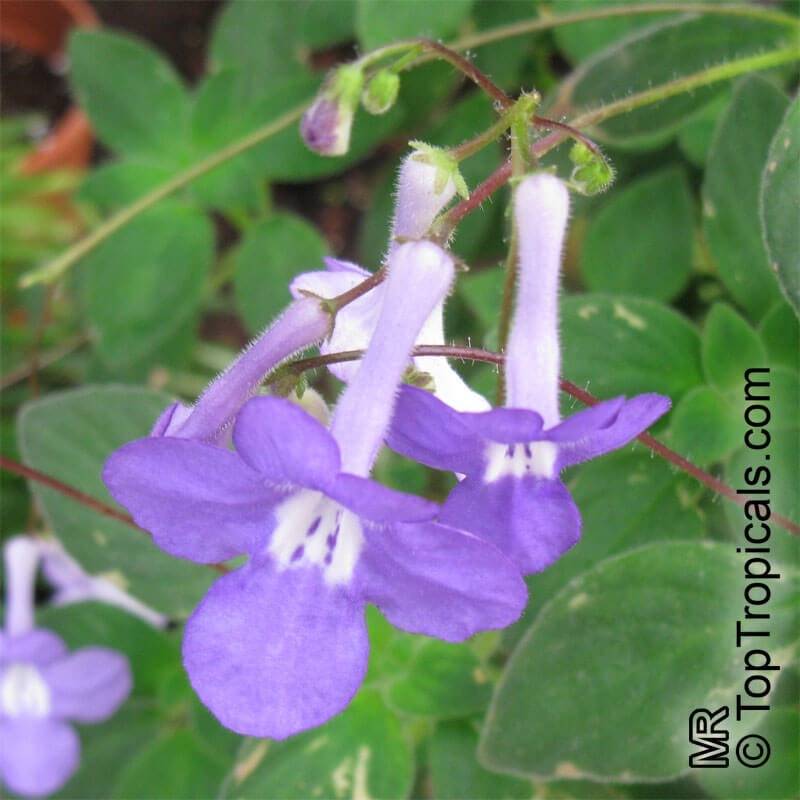
- The delicate lavender-blue flowers appear on 4 inch long, thin, wiry stems above the foliage, creating a floating effect. This is why Streptocarpella is sometimes called the “nodding violet.”
- Self-cleaning: No deadheading required
- Not a heavy feeder: Apply a balanced fertilizer (10-10-10) monthly in spring and summer, or use a slow-release fertilizer in spring
- Humidity & Care Notes
- Normal household humidity is sufficient—even in winter
- If overwintering, bring indoors once temperatures fall below 55 degrees.

Below: The long, wiry stems of streptocarpella flowers make it appear they are floating in mid-air.

Below: Hanging basket of Streptocarpella in a greenhouse with other Gesneriads. "Streptocarpella in a hanging basket" by Nzfauna is licensed under CC BY-SA 3.0. To view a copy of this license, visit https://creativecommons.org/licenses/by-sa/3.0/?ref=openverse.


Below: Streptocarpella 'Concord Blue' in full, glorious bloom. Photo courtesy Proven Winners, www.provenwinners.com

Where to Find Streptocarpella 'Concord Blue'
You might find Streptocarpella 'Concord Blue' at your big box store merchandised with the shade annual plants or hanging baskets. As it is a Proven Winners "Selection," purveyors of PW branded plants may also offer this.
It is sometimes available online from sites that specialize in tropical plants or specifically Gesneriads. A white form may occasionally be offered as well.
If you don't see Streptocarpella 'Concord Blue' at your local independent garden center, ask if they can get it -- and tell them Bill Palmer sent you.
You may also like