Few plants announce the changing of the seasons with as much charm as primroses. Belonging to the genus Primula, these beloved spring blooming flowers range from woodland perennials to decorative indoor specimens. For the discerning gardener, primroses offer early season color with an extraordinary range of hues, interesting foliage texture, and tidy growth habit—equally at home in curated borders, woodland gardens, and brightly lit interiors.
Primrose (Primula): A Refined Guide to Growing Spring’s Most Elegant Bloomers
This guide explores the most commonly grown primrose species in gardens and as houseplants, along with expert cultivation advice and garden design suggestions. Learn how primroses can bring a delightful pop of color to your spring garden or sunny winter windowsill.
Understanding Primroses: Form & Habit
Primroses typically grow in low rosettes of textured leaves, from which rise clusters of delicate, often vividly colored flowers. Most bloom in early to mid-spring, though some species extend into late spring or even early summer.
- Flowers: Often five-petaled with a contrasting “eye,” veining, or pictotee edge, borne singly or in clusters; individual flowers may be single or double; varied pastel and bright hues rival the color range of pansies and violas, lending themselves to designer-style indoor and outdoor containers.
- Leaves: Oblong to spatulate, crinkled or smooth, forming basal rosettes.
- Habit: Compact and clump-forming; some species grow upright with tiered flower whorls.
- Climate: Most primroses prefer cool climates and partial sun, going dormant in temperatures over 80 degrees and scorching in hot midday sun. Indoors, bright light and cool room temperatures will prolong bloom.
Outdoor Garden Primroses
Primula vulgaris; Primula acaulis (Common Primrose and Hybrids)
P. vulgaris generally refers to the wild species type, while P. acaulis is most often used for cultivated hybrids of P. vulgaris--those found commonly in garden centers in spring.
- Habit & Appearance: A low-growing perennial forming tidy rosettes of wrinkled, mid-green leaves. Pale yellow, soft pink, purple, blue, or white flowers bloom singly or in small clusters just above the foliage. Hybrids come in every color of the rainbow, usually with a contrasting eye in the center, and may bear flat, single blooms or ruffled double blooms.
- Height: 4–8 inches; spread 4 to 6 inches
- Bloom Time: Late winter to early spring
- Lifecycle Type: Hardy perennial USDA Zones 4-8 (often treated as short-lived but self-seeding)
- Light: Partial shade; tolerates morning sun. Full winter sun, such as under deciduous trees, is tolerated with cooler temperatures and sufficient moisture.
- Soil: Moist, humus-rich, well-drained, slightly acid (pH 6.5 is optimal)
- Water: Consistently moist, never waterlogged
- Fertilizer: Light feeding in early spring with balanced fertilizer
- Temperature: Prefers cool conditions (below 65 degrees for best blooming)
- Planting: Very tolerant of transplanting, even when flowering. Crown must be planted at soil level (deeper planting will encourage crown rot). Space 6 inches apart.
- Maintenance: Deadhead to extend bloom; divide clumps every 2–3 years. May go dormant in hot summers with daytime temps over 80 degrees.
- Garden Use: Border and path edging; underplanting deciduous shrubs and trees; massed as ground cover for smaller areas, especially in combination with spring blooming bulbs; containers
- Companion Plants (Outdoor): Pair with hellebores, pulmonaria, hostas, ferns, and early tulips for layered woodland elegance. If planting newly purchased plants from the garden center in late winter, note that frost or freeze may damage or discolor the blooms, but the plants should survive. Using fabric row covers can be beneficial to preserve floral display.
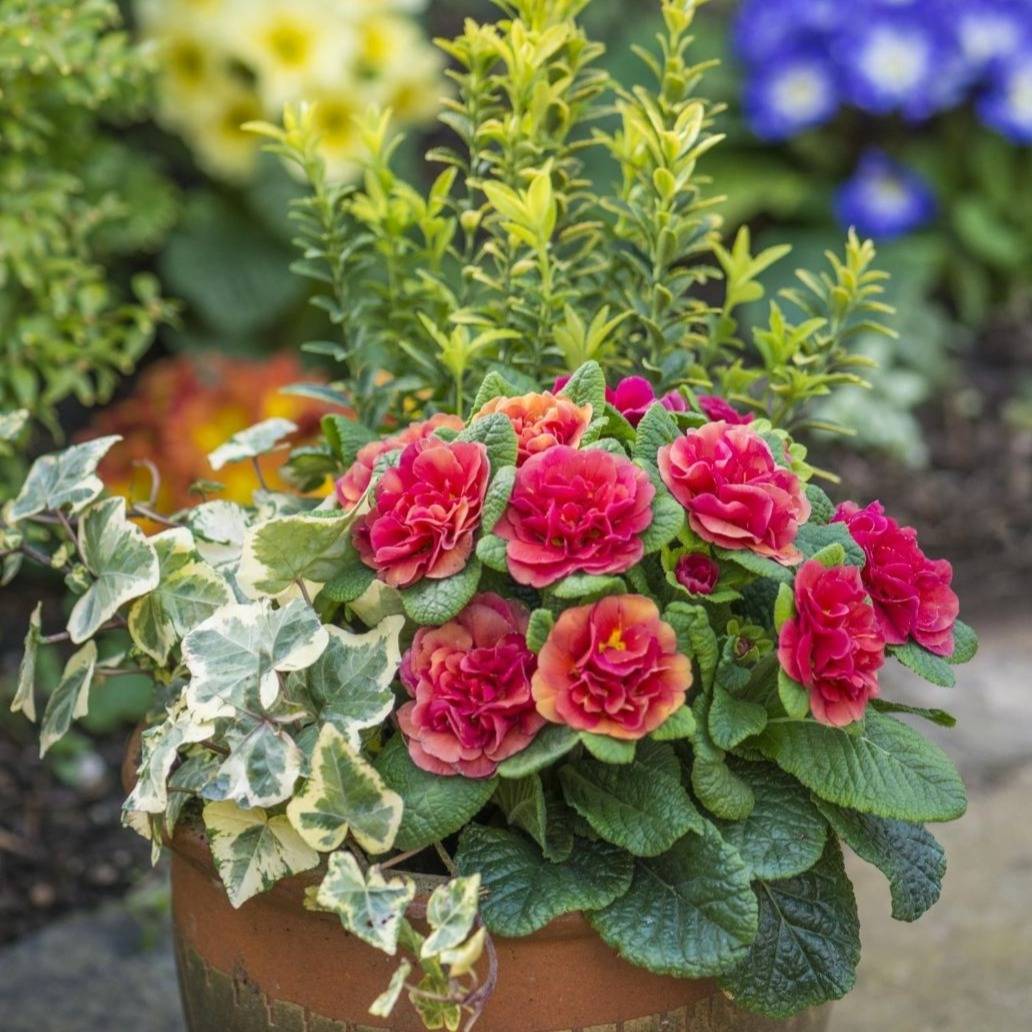
- Container Companions include pansies, violas, pericallis, ranunculus, mosses, ivy, alyssum, dianthus, forced bulbs, carex, and acorus. Combine with lime green Scotch moss and small stems of pussy or curly willow, or mass tonal shades in a low bowl planter for a stunning decorator style spring display.
- Indoor "Houseplant" Care: These are often desired as indoor accents, but they should be considered temporary guests--perhaps a couple of weeks. For the longest lasting display, purchase with only a few flowers open and plenty of buds. Keep the room as cool as possible and provide bright light--some direct winter sun in northern areas is fine. Removing to a cooler (50 to 60 degrees) room overnight will also help them last longer. Fertilize weekly at half-strength. Avoid overhead watering to discourage botrytis (gray mold)--water just under the leaves. Remove any yellowing leaves and faded flowers immediately--pinch stems back to the center to deadhead. Keep moist but not wet. Once flowers have faded, plants may be transferred to the garden if desired.
- Primula japonica (Japanese or Candelabra Primrose)
- Habit & Appearance: Tall, dramatic candelabra-style primrose with tiered whorls of magenta, crimson, pink, or white flowers rising above lush, elongated green leaves.
- Features: Deer, rabbit resistant; heat and humidity tolerant
- Height: 12–24 inches; spread: 12-15 inches
- Bloom Time: Late spring to early summer
- Lifecycle Type: Hardy perennial, USDA Zones 4-8
- Light: Partial shade to full shade
- Soil: Rich, moisture-retentive soil
- Water: Requires consistent moisture; ideal near ponds or streams
- Fertilizer: Organic compost in spring
- Maintenance: Remove spent flower stems; divide every few years
- Garden Use: Woodland gardens with strong vertical layering; waterside plantings and rain gardens; back-of-border placement in shaded perennial beds; naturalistic drifts beneath open-canopy trees
- Companion Plants (Outdoor): Astilbe, ligularia, rodgersia, Japanese and Siberian iris, and large ferns create a luxurious, moisture-loving display.
Primula veris (Cowslip)
- Habit and Appearance: A charming European native with nodding, bell-shaped flowers held in loose umbels atop slender stems. Blooms are typically rich golden-yellow with deeper orange markings at the throat, though cultivated selections offer apricot and reddish tones. Leaves form low rosettes of softly wrinkled, oblong foliage in mid-green. The overall effect is naturalistic and meadow-like rather than bold.
- Height: 6–12 inches; spread: 8–12 inches
- Bloom Time: Mid to late spring
- Lifecyle Type: Hardy. long-lived perennial USDA Zones: 4–8
Garden Use: More delicate and informal than common primrose, cowslip is ideal for naturalized plantings, wildflower meadows, and traditional cottage gardens.
- Light: Full sun to partial shade (tolerates more sun than most primroses)
- Soil: Well-drained, moderately fertile soil; tolerates slightly alkaline conditions
- Water: Average moisture; more drought-tolerant than other primulas once established
- Fertilizer: Light compost top-dressing in spring
- Temperature: Prefers cool climates
- Maintenance: Remove spent flowers to prevent gentle self-seeding (unless naturalizing is desired); divide every 3-4 years
- Companion Plants (Outdoor): For elegant, pastoral combinations, combine with Camassia, early narcissus, Myosotis (forget-me-nots), Alchemilla mollis (lady's mantle), and native grasses. Cowslip pairs beautifully with bulbs in meadow-style plantings and beneath open-canopy trees.
- Primula denticulata (Drumstick Primrose)
- Habit & Appearance: Bold and architectural, this species produces perfectly rounded, globe-shaped flower heads resembling ornamental drumsticks. Each sphere consists of dozens of tightly packed florets in violet, lavender, white, pink, or deep purple. Leaves are broad, crinkled, and bright green, forming substantial basal rosettes that elongate after flowering. Clumping.
- Height: 10–18 inches (in bloom); Spread: 12–18 inches
- Bloom Time: Early to mid-spring
- Lifecycle Type: Hardy perennial, reliably in USDA Zones 4–8
- Light: Partial shade; tolerates morning sun
- Soil: Rich, moisture-retentive, heavy but well-drained
- Water: Consistent moisture during active growth: resents summer dryness
- Fertilizer: Balanced fertilizer in early spring
- Temperature: Cool spring conditions preferred (native to Himalayan region)
- Siting Tips: In hot southern climates, may struggle unless planted in protected shade with ample moisture.
- Maintenance: Remove flower stems after bloom to redirect energy to foliage; divide clumps every few years
- Garden Uses: More structured and dramatic than many primroses. Exceptional for formal borders, mass plantings, and container displays.
- Companion Plants (Outdoor): Hellebores, Pulmonaria (lungwort), Brunnera, Tulips, ferns
- In containers: Combine with trailing ivy or violas for refined spring arrangements.
- Primula vialii (Orchid Primrose)
- Habit & Appearance: Unlike the familiar spring primroses, this striking perennial produces upright spikes of red buds that open into lavender-pink flowers in early summer. The effect resembles a tiny bicolor torch rising above fresh green foliage. Clumps enlarge by forming offsets and will colonize in favorable conditions.
- Height: 12–18 inches (in bloom); Spread: 10--12 inches
- Bloom Time: Late spring to early summer (May--July).
- Lifecycle Type: Hardy perennial, reliably in USDA Zones 5--8
- Light: Partial shade; tolerates morning sun; tolerates more sun in northern climates if soil stays moist
- Soil: Rich, moisture-retentive, well-drained; slightly acidic to neutral pH. Amending with leaf-mold or compost is beneficial.
- Water: Consistent moisture, especially in warmer regions; resents summer dryness
- Fertilizer: Balanced fertilizer in early spring
- Temperature: Cool summers extend flowering for several weeks
- Siting Tips: Prefers cool, moist, sheltered locations
- Maintenance: May be short-lived, but can reseed; divide clumps every 3 to 4 years
- Garden Uses: Adds a striking vertical accent to woodland garden edges, moist borders or naturalistic meadows, rain gardens, bog gardens, streamside or pondside plantings, or shaded cottage gardens.
- Features: Attracts pollinators; deer and rabbit resistang.
- Companion Plants (Outdoor): Ferns, Hosta, Astilbe, Carex, Astrantia, Sanguisorba (Japanese burnet), Ajuga, Primula japonica

Below: Primula acaulis 'Belarina Cobalt Blue' glows in a container partnered with small narcissus and golden variegated Acorus (sweet flag). Photo courtesy Ball Horticulture, Inc., www.ballhort.com

Below: Primula acaulis 'Primera Wine Flame Shades.' Photo courtesy Ball Horticulture, Inc., www.ballhort.com

Below: Primula acaulis 'Blue Zebra.' Striping is more pronounced with cooler temperatures and bright light, and may muddy with warmer weather and direct sun. Photo courtesy Ball Horticulture, Inc. www.ballhort.com

Below: Outdoors, primula may be subject to snail and slug damage in overly damp conditions. This plant is ready to be deadheaded--flower stems should be pinched out at the center of the plant. Note the ragged edges of the flowers--this is likely damage from house sparrows tearing the petals to get to the nectar--yellow flowers are preferred. Photo courtesy hoerwin56 on Pixabay.

Below: Primula vulgaris 'Oakleaf Yellow Picotee" has intriguing starry flower clusters on longer stems and deeply lobed foliage. Photo courtesy Ball Horticulture, Inc. www.ballhort.com

Below: The vibrant double blooms of Primula acaulis 'Primlet Scarlet Red' resemble miniature roses. Photo courtesy Ball Horticulture, Inc.

Below: Primula japonica 'Miller's Crimson' is deer and rabbit resistant, happy in consistently moist soil in part shade, and particularly amenable to damp woodland, streamside, and bog sites. Photo courtesy US Perennials, usperennials.com

Below: Primula japonica 'Appleblossom,' photo courtesy US Perennials, www.usperennials.com

Below: Primula veris, Cowslip, in naturalized meadow planting at woodland edge. Photo courtesy loggawiggler on Pixabay.

Below: Primula denticulata, Drumstick Primrose, blooms in early to mid-spring. Photo courtesy Ball Horticulture, Inc., www.ballhort.com

Below: Primula denticulata, Drumstick Primrose. Photo coutesy pezibear on Pixabay.

Below: Primula vialii, Orchid Primose, Drumstick Primrose, is one of the latest blooming primroses, with flowering ocurring in late spring to summer. Photo courtesy Ball Horticulture, Inc., www.ballhort.com

Primroses for Indoor Elegance (and Seasonal Bedding)
- Primula obconica (German Primrose)
- Habit & Appearance: Rounded clusters of lilac, pink, lavender, red, or white flowers held above soft, heart-shaped leaves. Modern strains are less irritating to sensitive skin as they have little or no primin (the contact allergenic substance found in the leaves).
- Height: 8–12 inches
- Bloom Time: Winter through spring
- USDA Hardiness Zones: 10-11 (grown as houseplant elsewhere)
- Lifecycle type: Tender perennial, typically grown as annual or houseplant.
- Light: Bright, indirect light
- Soil: Well-drained, slightly acidic potting mix
- Water: Keep evenly moist; avoid soggy roots
- Fertilizer: Diluted liquid fertilizer every 2–3 weeks during bloom
- Temperature: 55–65°F preferred
- Maintenance: Deadhead regularly; discard after bloom or move outdoors in mild climates
- Companion Plants (Indoor): Cyclamen, phalaenopsis orchids, ivy, and maidenhair ferns for refined indoor compositions.
- Primula malacoides (Fairy Primrose)
More delicate and ethereal than German primrose, but filling the same niche as a colorful winter/early spring blooming indoor plant. The species is a perennial with mauve-pink flowers, native to the Himalayas. Cultivated pot plants may be pink, purple, white, or red and are sweetly scented.
- Habit & Appearance: Airy clusters of soft lavender, pink, or white blooms, often with a contrasting small yellow eye, float above delicate, scalloped foliage. Heavily veined and ruffled, shallowly incised ovate green leaves.
- Height: 6–18 inches
- Bloom Time: Late winter to spring
- USDA Zones: 10–11 (houseplant in cooler regions)
- Lifecycle Type: Annual or tender perennial
- Light: Bright, indirect light
- Soil: Moist, well-drained mix
- Water: Even moisture; sensitive to drought
- Temperature: Cool indoor conditions preferred (below 65 degrees, with flowers lasting longest between 50 and 55 degrees).
- Maintenance: For longer lasting plants, increase humidity by placing on tray filled with pebbles and water. Pinch spent blooms to prolong flowering
- Companion Plants (Indoor): Calceolaria, polka dot plant, cineraria and small ferns for pastel or bright seasonal displays.
- Primula sinensis (Chinese Primrose)
- Habit & Appearance: Large, frilled or scalloped flowers in jewel tones—crimson, magenta, violet, blue, and white—often with contrasting centers. Leaves are softly hairy and bright green.
- Height: 8–12 inches
- Bloom Time: Winter to spring
- USDA Zones: 10–11
- Lifecycle: Annual or short-lived perennial
- Light: Bright, filtered light
- Soil: Loose, fertile, well-drained
- Water: Keep evenly moist
- Fertilizer: Biweekly feeding during bloom
- Maintenance: Remove faded flowers promptly
- Companion Plants (Indoor): Forced bulbs (like miniature daffodils), cyclamen, and decorative moss plantings.
Annual Bedding Primroses (Hybrid Polyanthus Types)
Often sold as early-season bedding plants, these hybrids of P. veris and P. vulgaris offer bold, saturated colors and compact growth. The flowers are generally held on longer stems that P. vulgaris or P. acaulis, and culture and uses are similar. They are commonly grown as cool-season annuals in warmer climates and perennials in cooler zones (4–8).
- Ideal for: Containers, window boxes, formal edging.
 'Touch Me Midi Dark Orange' Primula obconica is primin-free. Photo courtesy Ball Horticulture, Inc.
 'Touch Me Pricanto Red ' Primula obconica , with vintage-look red and lime flowers. Photo courtesy Schoneveld Breeding.
 'Libre Mix' Primula obconica exhibits both jewel toned and pastel shades. Photo courtesy Ball Horticulture, Inc.
 'Prima Lilac' Primula malacoides (Fairy Primrose) bears showy heads of delicately textured blooms. Photo courtesy Ball Horticulture, Inc.
 Hybrid polyanthus primrose generally have clustered flowers on longer stems. 'Pollyana Persian Weave' Primula polyanthus, photo courtesy Ball Horticulture, Inc.
Primrose Care Guide: Expert Growing Advice
- Light Requirements
- Most primroses prefer partial shade.
- Indoors: bright, indirect light.
- Avoid hot afternoon sun.
Soil
- Rich in organic matter
- Well-drained yet moisture-retentive
- Slightly acidic to neutral pH
- Temperature
- Thrive in cool conditions (50–65°F ideal).
- Heat shortens bloom time.
- Watering
- Keep soil consistently moist.
- Never allow to dry out fully.
- Avoid standing water.
Fertilizing
- Balanced, diluted fertilizer during active growth.
- Avoid heavy nitrogen (reduces flowering).
Maintenance
- Regular deadheading prolongs flowering.
- Remove yellowing leaves.
- Divide hardy perennials every few years.
Are Primroses Annuals or Perennials?
- Hardy species (e.g., P. vulgaris, P. japonica, P. denticulata, P. veris): Perennials in Zones 4–8.
- Tender species (e.g., P. obconica, P. malacoides, P. sinensis): Perennials in Zones 10–11; grown as annuals or houseplants elsewhere.
- Many gardeners treat primroses as seasonal color plants, but with proper care, hardy types naturalize beautifully.
Designing with Primroses
- Use drifts of common primrose beneath deciduous trees.
- Combine Japanese primrose with reflective water features.
- Plant pastel primroses in wicker baskets for a charming Easter display, or indoors group pots in an English-style garden trug and surround with sphagnum moss.
- Integrate primroses into structured parterre gardens for early-season refinement.
- Primroses excel at bridging winter and spring, making them essential spring blooming plants in temperate landscapes.
- Use Primula veris in sweeping drifts for romantic meadow effects.
- Mass Primula denticulata in rhythmic clusters for architectural punctuation.
- Combine both Primula veris and Primula denticulata with other spring blooming plants to extend seasonal interest from late winter through early summer. These two species offer contrasting personalities—one pastoral and delicate, the other bold and sculptural—making them invaluable additions to sophisticated spring garden compositions.
Notable Varieties
- Unique blue and white striped flowers
- Height: 6 - 8"
- Width: 8"
Danessa series Primula acaulis
- Very early flowering and compact with excellent heat tolerance.
- No cold period needed for initiating bloom.
- Height: 2 - 3"
- Width: 6"
Dania Mix Primula acaulis
- Very early blooming; showy bright shades of flowers on a compact plant
- Height: 4"
- Width: 6"
Danova Series Primula acaulis
- 1 to 1.5 inch fragrant blooms on a compact plant.
- Tolerant of heat and drier conditions.
- Solids and bicolors
- Hardiness Zone: 5a - 8b
- Height: 4 - 6"
- Width: 6 - 7"
Elodie Double Primula acaulis
- Tall, strong stems bear large double blooms with ruffled-edge petals, creating a romantic look
- Pink, peach, yellow, white, red, and blue shades
- Height: 8"
- Width: 8"
Hethor Giant Primula acaulis
- Compact plant with large 1 to 1.5" flowers
- Colors include shades of red, pink, blue, yellow, white, and wine
- Height: 4 - 6"
- Width: 6 - 8"
Paradiso Double Light Rose Primula acaulis
- Free-blooming, compact plant with double flowers that resemble roses
- Height: 4 - 6"
- Width: 5 - 6"
Primera Primula acaulis
- Robust plant with large, fragrant flowers does will indoors or in the garden or containers
- Bright shades including red, blue, yellow, orange, pink, and cream
- Height: 5 - 6"
- Width: 5 - 6"
Primlet® Formula Mix Primula acaulis
- Very sweet look, with delicate clustered double blooms resembling mini rose bouquets
- Fragrant
- Height: 5 - 6"
- Width: 5 - 7"
- One of the longer lasting varieties for indoor use
Bouquet Perfect series Primula vulgaris (Proven Winners)
- Well-rounded habit
- Early and profuse blooming; long-lasting sterile double flowers up to 2 to 2.5" resemble a flower bouquet
- 7 colors: red, pink, golden yellow, white, violet, violet & white bicolor and blue
- USDA Hardiness Zones 4-8
- Height: 5-8 "
- Width: 10-12"
Belarina and Prima Belarina series Primula vulgaris
- Cold and heat tolerant primrose with 1 to 1.5" fully double jewel-toned flowers
- Colors include red, yellow, pink, blue, cream, yellow w/coral highlights and edges, and white w/blue picotee edge
- USDA Hardiness zones 4-8
- Height: 5 - 8 "
- Width: 10 - 12"
'Ronsdorf' Primula denticulata
- Hybrids in colors of magenta, white, and light purple
- Height: 10-12"
Width: 10-12"
- Well-rounded plant with an extended bloom period. Shades of pink, purple, blue, peach, and white intensify as the plant matures. Fragrant.
- Little to no primin
- Height: 8 - 10" (20 - 25cm)
- Width: 6 - 8" (15 - 20cm)
- Hardiness USDA Zone 11a, but most commonly grown as houseplant
Original Mix Primula obconica
- Larger plant with larger flowers and long bloom period
- Primarily in shades of blue, pink, and white including bicolors, on very thick, sturdy stems.
- Contains primin
- Height: 12 - 13"
- Width: 6 - 8"
- Shade, Partial Sun; bright light indoors
- Rounded, compact plants with firm stems and long flower life (blooms up to 30 days indoors)
- Colors include white, blue, magenta, orange, rose, pink, and red/white and blue/white bicolors
- 3 sizes, Mini, Midi, and Large
- Primin-free
- Height: Mini 5-7"; Midi 6-10" ; Large 10-14"
- Width: similar to heights
- Partial sun, winter sun; Bright light indoors
- Best indoor temperatures 55-70 degrees
Touch Me Picanto F1 series Primula obconica
- Unique vintage-hued blooms in lime, blue, and red bicolors
- Overall similar to Touch Me Midi with similarly sized flower heads, but individual flowers are smaller, more numerous, and densely packed, with the appearance of a mini-hydrangea bloom
- Partial sun, winter sun; Bright light indoors
Primula vialii Miracle (Poker Primrose)
- Long blooming scarlet and lavender pink spikes of flowers
- Hardiness Zone: 4a - 8b
- Blooms Late Spring, Summer
- Plant Habit: Mounded, Upright
- Height: 12 - 16"
- Width: 10 - 12"
- Partial shade, shade, winter sun
- Excellent for borders, rock gardens and edging.
Primula vialii
- Hardiness Zone: 4a - 8b
- Blooms Late Spring, Summer
- Plant Habit: Upright
- Height: 12 - 18"
- Width: 8 - 10"
- Partial shade, shade, winter sun
- Good cut flower
Lighthouse Blue Primula polyanthus
- Heavy bloomer with longer flower stems on a compact plant with semi-evergreen to evergreen textured leaves.
- Height: 8" (20cm)
- Width: 6" (15cm)
- Partial Sun, Winter Sun
SuperNova Mix Primula polyantha (F1 Hybrid)
- Prolific early bloomer with extra large, lightly fragrant flowers with excellent disease and temperature range tolerance
- Hardiness Zone: 6a - 9b
- Height: 8"
- Width: 7 - 8"
- Partial Sun, Winter Sun
Piano series Primula elatior (F1 Hybrid)
- Large flowers, needs no cold period to initiate blooming
- 8" H x 7" w
- Partial sun, winter sun
You may also like