An artfully crafted birdhouse is more than a decorative accent—it’s an investment in your garden’s beauty, biodiversity, and ecological balance. Attracting nesting birds to your landscape enhances its vitality, supports pollination and natural pest control, and brings year-round movement and song to your outdoor sanctuary.
Birdhouses: Choosing the Right Style, Size & Placement for Your Garden
An artfully crafted birdhouse is more than a decorative accent—it’s an investment in your garden’s beauty, biodiversity, and ecological balance. Attracting nesting birds to your landscape enhances its vitality, supports pollination and natural pest control, and brings year-round movement and song to your outdoor sanctuary.
Why Attract Birds to Your Garden?
Thoughtfully designed birdhouses help transform your landscape into a thriving ecosystem. The benefits include:
- Natural Pest Control: Many cavity-nesting birds feed heavily on insects, caterpillars, beetles, and larvae.
- Pollination & Seed Dispersal: Some species support plant diversity through pollination and spreading seeds.
- Biodiversity Support: Nest boxes offset habitat loss from urbanization and landscaping.
- Year-Round Beauty: Birds bring movement, song, and seasonal rhythm to formal gardens and relaxed landscapes alike.
- Winter Shelter: Many species use birdhouses as protective roosting sites during cold months.
A well-placed birdhouse adds elegance while actively supporting wildlife conservation.
Choosing the Right Birdhouse for Each Species
Different birds require different dimensions. Selecting the proper interior floor space and entrance hole size ensures safety and encourages occupancy. A hole that is too large invites invasive species like European starlings. Too small, and your desired birds cannot enter.
Birds that use boxes are generally "secondary" cavity nesters, using existing holes made by other birds or animals. "Primary" cavity nesters such as woodpeckers and some nuthatches create their own nesting holes, but may sometimes use a birdhouse of the proper size in the right location. Chickadees and white-breasted nuthatches, though capable of excavating softer wood, are more likely to use existing holes when available.
Non-cavity nesters, like robins, house finches, mourning doves, cardinals, and catbirds, may be encouraged to nest near your home on a "nest shelf," a covered, open-fronted house. Some, like cardinals, will require a great deal of vegetation or other cover, while others such as robins are less particular. Wrens, although cavity nesters, will often use these types of structures as well.
Below are general guidelines for common North American cavity-nesting birds. Note that these are not hard and fast rules--birds are adaptable, especially where heavy competition for nesting sites exists.
- Carolina or Black-Capped Chickadee
Interior floor: 4” x 4”
Interior height: 8 - 10"
Entrance hole: 1 1/8" diameter
Mounting height 5 - 15 feet
- Tufted Titmouse
Interior floor: 4” x 4”
Interior height: 8 - 10"
Entrance hole: 1 1/4"
Hole placement: 6 - 8" from floor
Mounting height 6 - 15 feet
- Red Headed Woodpecker
Interior floor: 6" x 6"
Interior height: 12 - 14"
Entrance hole: 2" diameter
Hole placement: 10-11" from floor
Mounting height 10 - 20 feet
Fill with 2 inches of wood chips or shavings for them to remove (to mimic excavation - this is an important part of their nesting habit)
Prefers lightly wooded areas with scattered trees, especially near orchards, wetlands or transition areas between grasslands and woodland
- Carolina and Bewick's Wren
Interior floor: 4” x 4”
Interior height: 6 - 8"
Entrance hole: 1.5" diameter
Hole placement: 1 - 6" from floor
Mounting height 6 - 10 feet
- House Wrens
- Interior floor: 4” x 4”
- Entrance hole: 1-1/8” diameter
- Hole placement: 1 - 6" above floor
- Mounting height: 5–10 feet
- Eastern & Western Bluebirds
- Interior floor: 5” - 5.75" x 5” - 5.5"
- Interior height: 8–12”
- Entrance hole: 1.5” diameter
- Hole placement: top of hole 8.75" from floor
- Mounting height: 4–6 feet: generally on a pole or post in open areas, but I have had Eastern bluebirds use a birdhouse mounted on a trellis against the wall of my house, in a 20 x 20 fenced yard. Pole mounting vs. tree or T-post mounting is recommended to discourage predators.
- Tree Swallows
- Interior floor: 5” x 5”
- Entrance hole: 1-3/8” diameter
- Mounting height: 5–15 feet near open fields or water
- Downy Woodpeckers
- Interior floor: 4” x 4”
- Entrance hole: 1 1/4” diameter
- Mounting height: 5–20 feet
- Flicker
- Interior floor: 7" x 7"
- Interior height: 16 - 18"
- Entrance hole: 2.5” diameter
- Hole placement: 14 - 16" above floor
- Mounting height: 6 –20 feet
- Screech Owl
- Interior floor: 8" x 8"
- Interior height: 12 - 15"
- Entrance hole: 3” diameter
- Hole placement: 9 - 12" from floor
- Mounting height: 10 – 30 feet
- Wood Duck
- Interior floor: 10" x 18"
- Interior height: 20 - 24"
- Entrance hole: 4” x 3"
- Hole placement: 12 - 16" from floor
- Mounting height: 10 – 20 feet
- Great Crested & Ash Throated Flycatcher
- Interior floor: 6" x 6"
- Interior height: 8 - 10" (6 - 10" for Ash Throated)
- Entrance hole: 1-3/4" (1.5" for Ash Throated)
- Hole placement: 6 - 8" from floor
- Mounting Height: 8 – 20 feet (4 - 10' for Ash Throated)
- Near woodlands or orchards preferred
- Purple Martins
Require specialized multi-compartment housing at a minimum 10-15 foot height, rather than single boxes. They will also nest in large groupings of gourd birdhouses.
Interior Design: Proper Ventilation, Drainage & Shape of Birdhouses
- Ventilation
Birdhouses require airflow to prevent overheating. Look for:
- Small ventilation gaps beneath the roofline
- Side wall vents near the top
- Drainage
Moisture accumulation can endanger nestlings.
Include:
- Small drainage holes in the floor
- Slightly recessed floor panel (about 1/4" higher than the bottom)
- Ideal Shape
A simple vertical cavity works best. Avoid ornate internal shapes—birds value functionality over decoration.
Birds prefer:
- Rectangular or square interiors
- A slightly sloped roof that overhangs by 2" on the sides and 2 - 4" on the front for rain runoff
- Rough interior walls or interior grooves under the opening to help fledglings climb
Why Perches on Birdhouses Are Not Necessary (and Often Harmful)
Contrary to popular belief, perches are unnecessary and discouraged. Cavity-nesting birds do not use perches to enter their homes. A clean façade without a perch is both elegant and safer.
- Perches give predators (cats, raccoons) leverage.
- They allow invasive birds easier access.
- They increase vulnerability without benefit.
Proper Siting & Mounting of Birdhouses
- Mounting Guidelines
- Use pole mounts or posts rather than hanging from trees when possible.
Avoid attaching directly to tree trunks (easier predator access).
Position the entrance facing away from prevailing winds.
Provide partial shade in hot climates.
- Habitat Matters
- Bluebirds prefer open lawn or meadow.
- Wrens enjoy shrub borders.
Chickadees favor wooded edges.
Predator Protection Strategies for Birdhouses
Essential Strategies:
- Baffles on poles (cone or stovepipe style) to block raccoons and snakes.
- Metal hole guards to prevent enlargement by woodpeckers.
- Extended length hole guards that prevent predators from accessing eggs and nestlings.
- Maintain at least 5–10 feet clearance from jumping surfaces.
- Avoid feeding stations close to birdhouses. The farther away you can place your birdhouse from your feeder the better. Although this seems counterintuitive, the feeder will attract many more birds and rodents to the area, thus increasing the possibility that predatory species will find the nesting site.
- House sparrows and starlings are invasive species that should not be encouraged to nest. To exclude house sparrows from nesting, holes must be smaller than 1-1/4"; holes smaller than 1-9/16" will exclude starlings. If these birds are a problem in your area, extended hole guards may be necessary to keep them from attacking vulnerable eggs and nestlings of other birds, even with hole diameters as described above.
Winter Roosting: Year-Round Value
Birdhouses aren’t just for spring nesting. Your garden becomes a sanctuary even in the quietest season as birds seek protection from weather and predators.
During winter:
- Birds of the same species, or even multiple species may roost communally.
- Roosting reduces heat loss and improves survival.
- A well-insulated wooden house provides critical shelter from wind and snow.
For winter:
- Leave houses mounted.
- Ensure they are clean and dry.
- Consider adding windbreak placement.
You might consider adding a true 'roosting' house to your yard. Since heat rises, these structures have the entrance hole at the bottom to better trap warmth, and may also have several interior perches to accommodate multiple communal roosting birds like bluebirds, wrens, and nuthatches.
Cleaning & Seasonal Care of Birdhouses
Proper maintenance ensures repeat nesting. Regular maintenance prevents parasites and increases occupancy.
When to Clean:
- In between broods in summer if more than one clutch of eggs is produced (e.g. bluebirds)
- In late fall before winter (main cleaning)
- Again in late winter before nesting begins, to check for wasps or mice, or if used for winter roosting
How to Clean:
- Open hinged side or front panel. Birdhouses made without such access may require you to remove side or bottom panel screws.
- Remove old nesting material.
- Scrub with 1:9 bleach-to-water solution or soap and hot water.
- Rinse thoroughly and dry completely.
- Avoid harsh chemicals or fragrances.
Is Bird Flu a Concern with Birdhouses?
Highly Pathogenic Avian Influenza (HPAI) primarily affects:
- Waterfowl (ducks, geese)
- Shorebirds
- Poultry
Birdhouses themselves do not significantly increase bird flu risk when properly maintained. The small songbirds that use birdhouses—chickadees, wrens, bluebirds—are considered low risk for spreading bird flu, and transmission among backyard songbirds is rare.
Standard precautions:
- Wash hands after cleaning houses.
- Wear gloves during maintenance.
Materials Matter: Investing in a Quality Birdhouse
Fine craftsmanship ensures both beauty and ecological integrity.
For a beautiful garden aesthetic and long-term durability:
- Choose untreated cedar, cypress, or redwood, or cellular PVC.
- Avoid pressure-treated lumber.
- Use exterior-grade hardware and galvanized screws, not nails.
- Select designs with clean architectural lines that complement your landscape.
Birdhouses: Elevate Your Garden with Purpose
A thoughtfully selected birdhouse blends artistry with stewardship. By choosing the correct size, ensuring proper ventilation, mounting securely, excluding predators, and maintaining seasonally, you create a safe haven for birds and a living accent for your garden.
The reward is immeasurable: fledglings taking flight in spring, soft evening calls in summer, and quiet winter roosting in sculptural wooden shelters.
An elegant garden is not only seen—it is heard, felt, and alive.
For More Information:

Below: Bluebird box with a wooden hole guard, which aids in keeping predators from harming eggs or hatchlings, and minimizes damage by woodpeckers.

Flycatchers are less familiar birds that may use nest boxes near suitable habitat

Below: Red-headed Woodpeckers may use a suitably sized bird box in lightly wooded locations

Below: Robins and other non-cavity nesters can be encouraged to nest around your home on covered, open-fronted nesting platforms or "nest shelves"

Below: I was thrilled to discover white-breasted nuthatches had moved into the birdbox in my small yard several years ago. They excavated the hole to suit themselves.

Below: Purple martins are colonial nesters that require large "apartment" style houses erected at a much greater height than a typical birdhouse. Multiple gourd birdhouses grouped together can also be used. Due to the loss of natural nesting habitat these birds rely to a great degree on birdhouses.

Below: Purple martin house with multiple gourd houses

Below: Perches are not needed, and allow easier access for aggressive birds like house sparrows and starlings that attack eggs and nestlings.

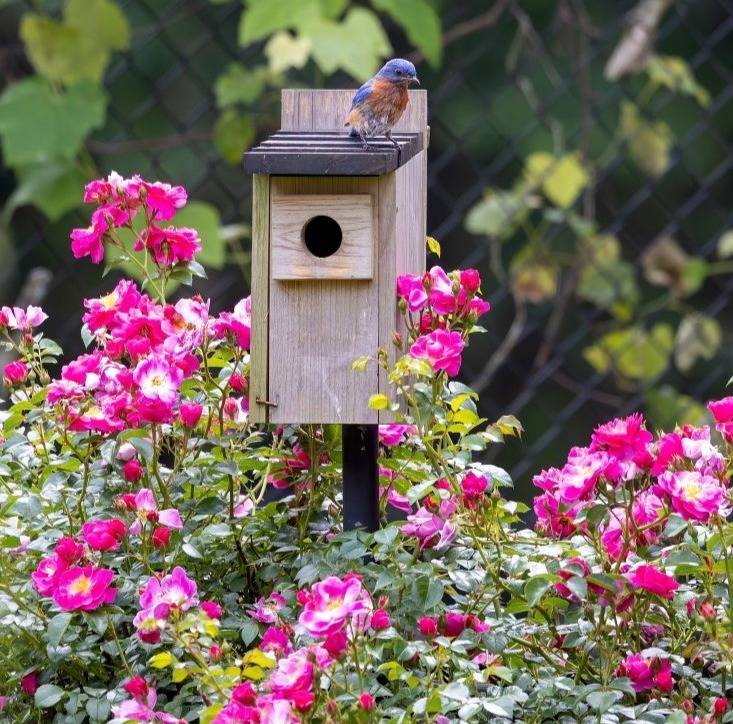
Below: While the ultimate siting for bluebird boxes is in, or facing, an open field, bluebirds that regularly visit your yard may nest in a suitably sized and placed bird house.

Below: This birdhouse shows two important features - hinged access for cleaning and a metal hole guard to protect from woodpecker and rodent damage.

Below: An example of hole guards that can be added to a birdhouse to protect inhabitants from aggressive bird species and predators

Below: Some of the damage to this birdhouse was caused by white-breasted nuthatches enlarging the hole prior to nesting. Squirrels, chipmunks, and woodpeckers can also cause similar damage. Metal hole guards can repair and prevent this.

Below: Baffles can be placed on bird posts to protect from predators

Below: Birdhouses should be cleaned of old nesting material, at least once a year prior to the nesting season. A hinged side, front, or roof facilitates access.

Below: Hinged birdhouse fronts or sides also allow for visualization of eggs and nestlings. This is usually done for research purposes and is best kept to a minimum and when the adults are foraging. However, songbirds do not have a particularly keen sense of smell, so the scent of humans will not usually cause them to abandon their nest.

Below: Sure signs of nesting (almost)! Note that some species will build more than one nest, ultimately using only one. In some cases this is to confuse predators. Male wrens often build several nests for their mate, with the female making the final choice. If activity ceases after two weeks, then it is likely an unused "dummy" nest.

Below: A well-crafted birdhouse truly elevates a garden, acting as a stunning focal point and vertical accent. Bird-safe PVC material has the advantage of being low maintenance, durable, and easy to clean.

You may also like