Winter containers bring color, texture, and structure to porches, patios, entryways, and other outdoor spaces when much of the garden is dormant. While summer planters often feature abundant flowers, winter displays can rely on evergreen foliage, contrasting textures, colorful branches, berries, and decorative accents to remain attractive through the colder months.
Best Conifers for Winter Containers: Arborvitae, Juniper, Spruce and More
There are many ways to create a winter container. Hardy evergreen shrubs and conifers provide a lasting foundation, while groundcovers, evergreen or semi-evergreen perennials, ornamental grasses, and cool-weather annuals add variety and seasonal color. Pansies, violas, ornamental kale, and ornamental cabbage are popular choices for fall and winter displays in suitable climates. Decorative branches and weather-resistant ornaments can provide additional interest.
For a container that offers more than a single season of beauty, start with a permanent evergreen centerpiece and change the surrounding plants as the seasons shift. Conifers are particularly well suited to winter containers, offering a remarkable range of shapes, sizes, and foliage colors. From compact, rounded arborvitae to upright spruces and gracefully trailing junipers, these evergreens provide structure and visual interest even when other plants are dormant.
Why Choose Conifers for Winter Containers?
Conifers are a group of woody plants that typically produce seeds in cones and have needle-like or scale-like foliage. This group includes familiar evergreens such as pines, spruces, firs, arborvitae, and many junipers. Although most conifers retain their foliage year-round, a few, including larches and bald cypress, lose their needles in fall.
Conifers are valued for their evergreen foliage and distinctive forms, making them natural choices for containers that need to look good throughout winter. Many dwarf and slow-growing varieties are well suited to growing in pots, where their shapes can serve as the focal point of a planting.
Coniferous shrubs provide structure and winter foliage color in shades of green, blue, yellow, gold, silver, purple, and bronze, with leaves that may resemble flattened sprays, cord-like tendrils, feathery plumes, spiky tufts, or fine needles. The widely varying habits offer considerable design flexibility as well.
Just one or two provide a lasting evergreen backdrop for seasonal flowers, while a colorful mix of upright, mounding, and trailing conifers with varying leaf textures can create a subtly beautiful container all on their own.
Choosing Conifers for Winter Containers
The best conifers for containers are generally compact, slow-growing varieties with attractive forms. Use an upright selection for height, a rounded or vase-shaped variety for additional color and texture, or a spreading cultivar to fill and soften the edges of a planter.
Almost any evergreen hardy in your zone can be used for the season, but if your aim is to keep the plant in the container for the rest of the year or even several years, you must choose more carefully. Consider the zone recommendations, mature size, growth rate, and pruning regimen to be sure it will not overtake the other plants or outgrow the space.
Plants in a container are more susceptible to freeze damage, as the roots lack the insulation that in-ground planting provides. Therefore, it is essential to select plants hardy to at least one to two zones colder than your own if you are looking for a longer-lasting planting. Adding several layers (about 2 to 3 inches) of large-bubble bubble wrap or other insulating material inside the container can protect the plants without detracting from the appearance of your planter.
Mature sizes generally refer to approximate landscape dimensions at 10 years. While plants grown in containers tend to remain much smaller, there is no guarantee. Dwarf cultivars are generally preferable for smaller planters--however, "dwarf" should not be misconstrued as "miniature" or even "small," but only as "smaller" than the non-dwarf cultivar. A "dwarf" conifer may easily reach 10 or more feet with time, for example.
Slow-growing conifers will grow approximately 6-12 inches per year when in the ground; fast growers 2 or more feet per year. For more permanent containers, avoid evergreens commonly used for fast-growing privacy hedges, like Green Giant Arborvitae or Leyland Cypress.
Some evergreens can be regularly sheared or even hard pruned to maintain size, while others will never regrow if cut back into old wood. Be sure to know what your plant can handle before pulling out the pruners. Plants that have finally overgrown their welcome can usually be switched to a larger container or added to the garden.
Most conifers will thrive in full sun; some will accept part sun. For best long-term growth, design the container so that it can be rotated to ensure all sides get enough light.
Excellent drainage is essential for all the varieties listed. Consider adding up to 50% coarse sand or perlite to the potting mix as long as co-inhabitants are agreeable, and avoid mixes with added moisture crystals.
Below are some of our favorite conifers for containers. We have concentrated on varieties typically commercially available in one gallon or smaller pots, as those offer the greatest versatility.
Note that the mature habits described may not be fully displayed (or even remotely evident) in very young plants--for example, dense, broad pyramidal or rounded evergreens may appear much thinner and more upright in a smaller grower pot.
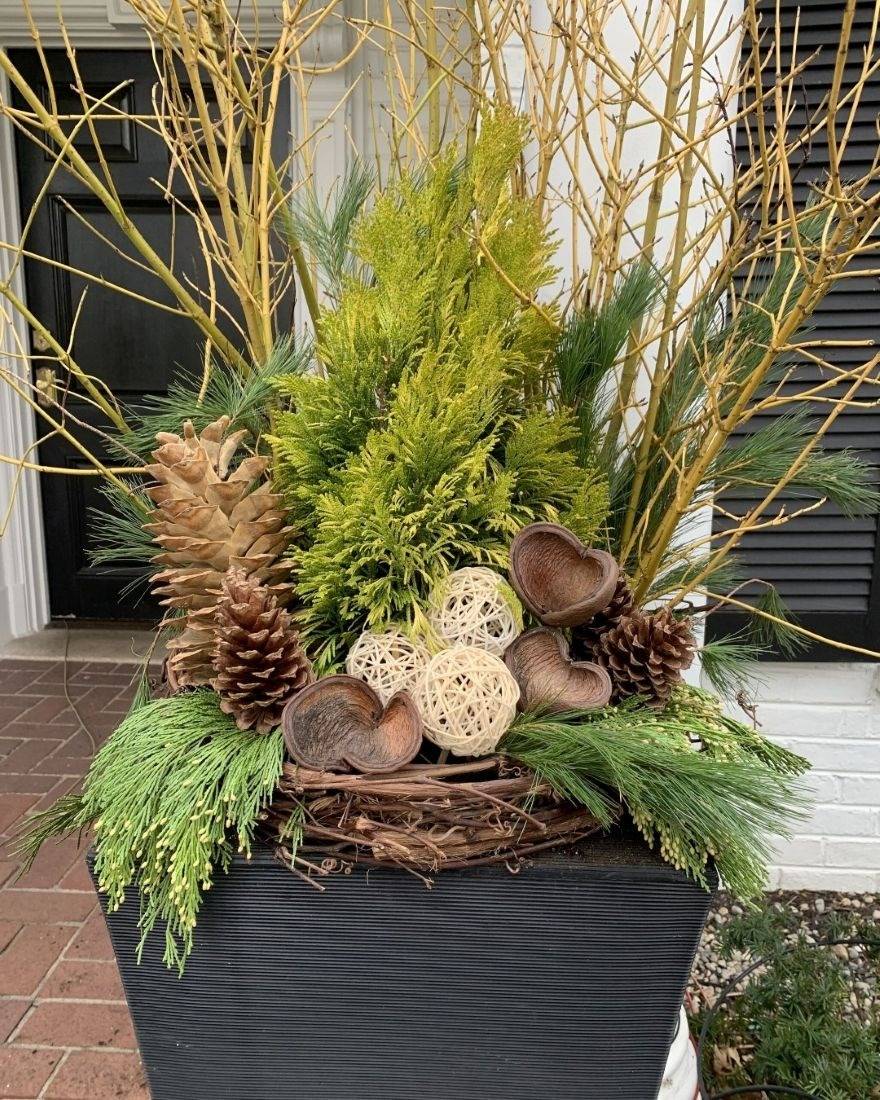
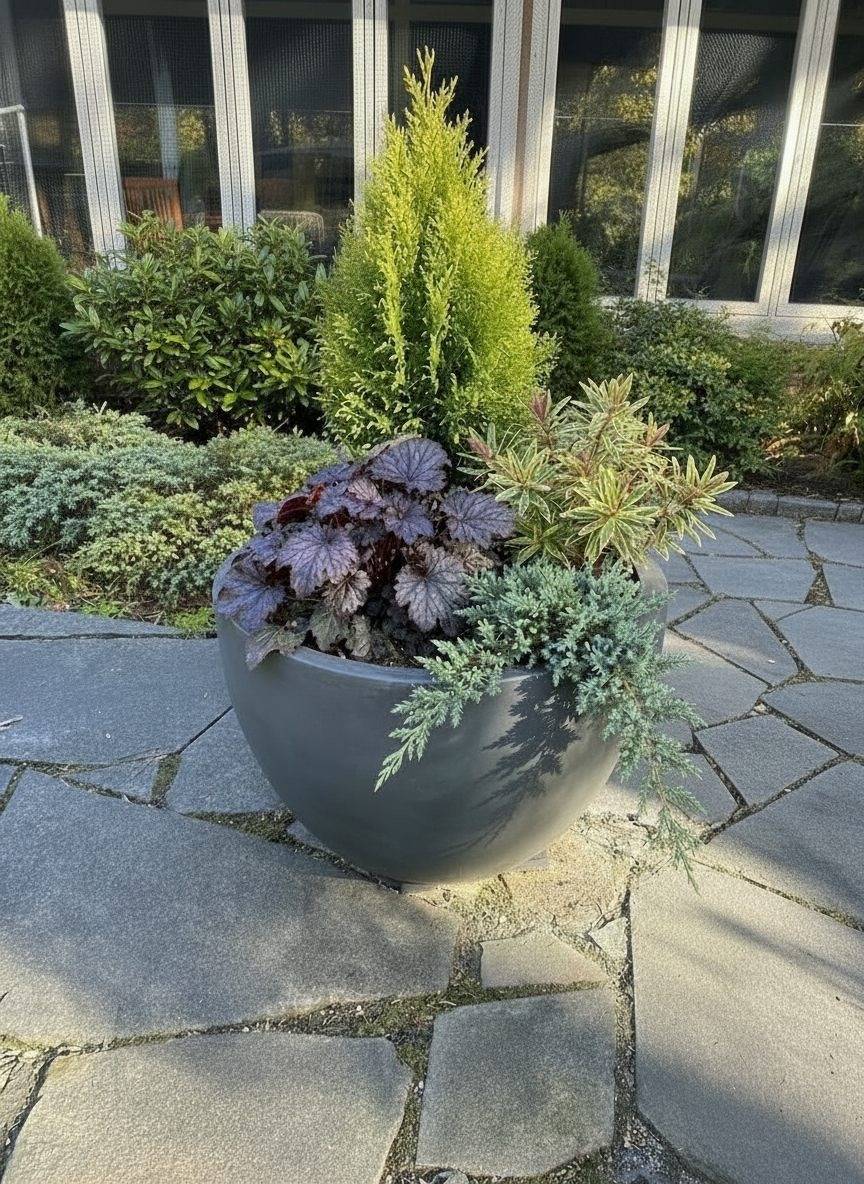
Below: Arborvitae 'Jantar', purple heuchera, blue spreading juniper, and Euphoriba 'Ascot Rainbow'.
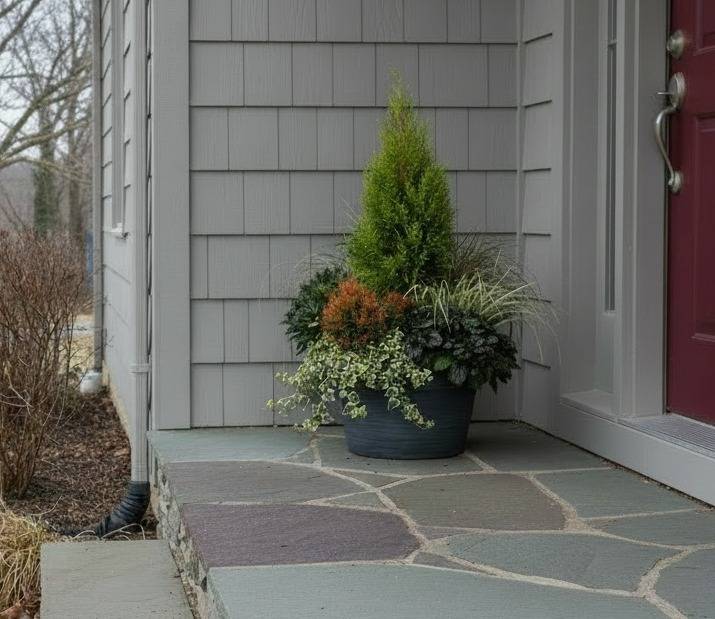
Below: Arborvitae, carex, euphorbia, heuchera, ivy, and 'Fire Chief' arborvitae
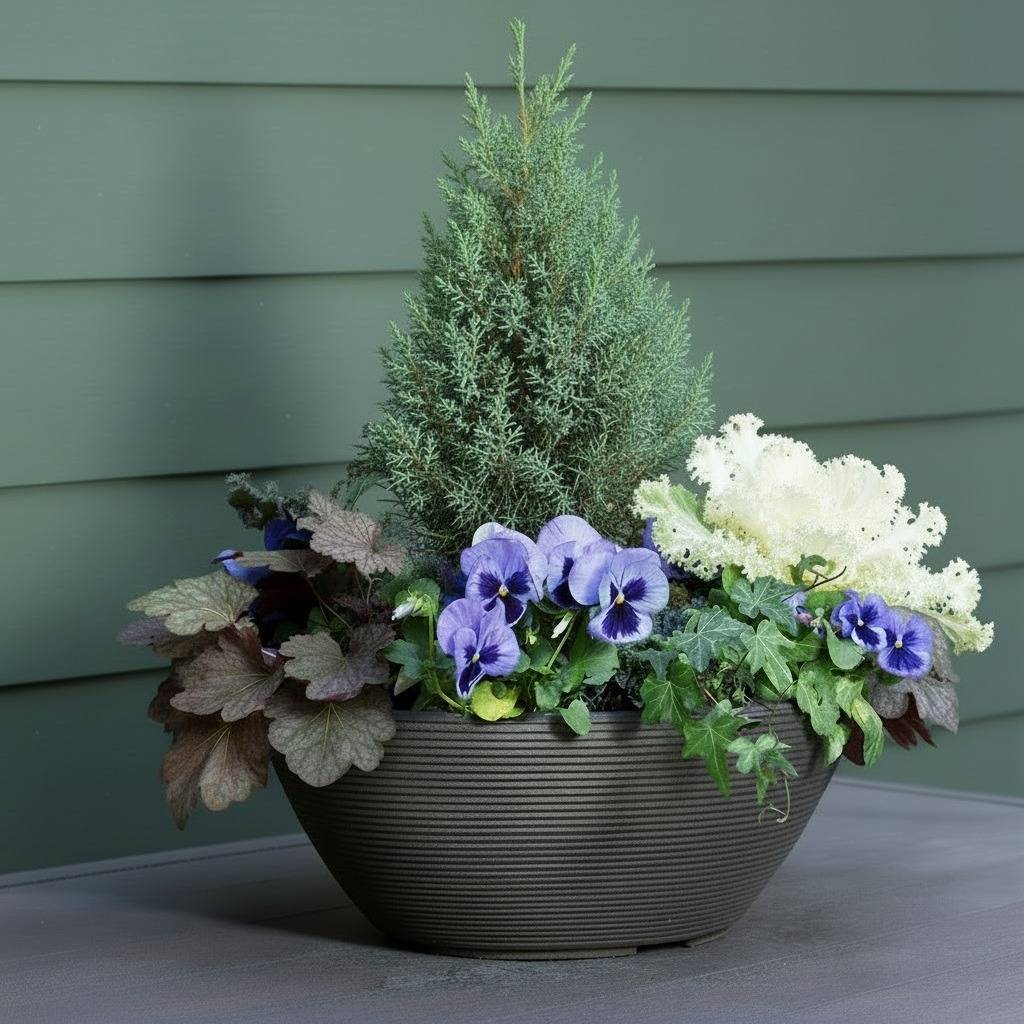
Below: Juniper, heuchera, ornamental kale, pansies, and ivy complement this low bowl planter
Upright Conifers for Height and Structure
Upright conifers create a strong vertical element in winter containers. They work especially well in tall planters flanking an entrance or as the central feature in a mixed arrangement.
- 'Jantar' Arborvitae (Thuja occidentalis): Zones 4-9; 10-15' high x 3-4' wide; narrow, upright; yellow-green in summer, warming to amber in winter
- 'Fluffy' Arborvitae (Thuja plicata): Zones 5-8; 10-15' high x 4-6' wide; upright pyramidal; golden yellow all year
- 'Franky Boy' Arborvitae (Thuja orientalis/Platycladus orientalis): Zones 5-9; grows slowly to 4-6' high x 3-4' wide; upright teardrop shape; lime-green with yellow tips in summer turning bronzy in winter; stringy foliage that droops on the ends for a soft and wispy appearance; can be lightly sheared for a neater shape if desired
- 'Black Dragon' Cryptomeria: Zones 6-9; grows slowly (but faster in youth) 6' high x 3' wide; dense, irregularly pyramidal to broad upright; very dark green with light green new growth; artistically sculptural at maturity, but this may be lost with very young plants--still, quite texturally appealing
- Pencil Point Juniper (Juniperus communis 'Compressa'): Zones 3-6, may struggle with heat and humidity farther south; very slow growing, 3-6' high x 1-1.5' wide; narrow, upright; dense juvenile foliage, silvery blue-green to bronze-copper in winter
- 'Blue Arrow' Juniper (J. scopulorum): Zones 4-9; 12-15' x 2-3'; very narrow, columnar habit; powdery silver-blue all year
- 'Blue Point' Juniper (J. chinensis): Zones 4-9, better for the south than others; slowly to 10-12' x 5-6'; tightly pyramidal; blue-green all year
- 'Moonglow' Juniper (J. scopulorum): Zones 3-7; slowly to 15-20' x 6-8'; broad pyramid at maturity, more upright when young; bright silvery blue, even more vivid in winter
- 'Wichita Blue' Juniper (J. scopulorum): Zones 3-7; slowly to 10-15' x 4-6'; pyramidal at maturity, upright when young; powder blue all year with a looser, more feathery look
- Dwarf Alberta Spruce (Picea glauca 'Conica'): Zones 2-8; slowly to 8' high x 5' wide; very densely pyramidal--the perfect little outdoor Christmas tree; deep green short needles with light green new growth; 'Tiny Tower' is a smaller cultivar, growing 4-6' high x 2' wide; see more info below under "Spruce"
- 'Stonehenge' Yew (Taxus x media) Zones 4-7, 10' tall x 4' wide, columnar; dark green with lighter green new growth. 'Stonehenge Skinny' grows 6-8' high x 1' wide, so is a better choice long-term, but very young plants may not have much presence.
Rounded and Mounding Conifers
- 'Whipcord' Arborvitae (Thuja plicata): Zones 5-7; grows slowly to 4 to 5' high and wide; rounded habit with green, stringy, shaggy, cascading branchlets that turn bronzy-orange in winter
- 'Whip it Good' Arborvitae (T. occidentalis): Zones 3-9; 3-5' high and wide; rounded; similar look to 'Whipcord' but much denser, faster growing, and maintains green color in winter
- 'Fire Chief' Arborvitae (Thuja plicata): Zones 5-8; grows slowly to 2-4' high and wide; rounded dome shape; soft, dense foliage with coppery orange tones in winter and gold to lime green in summer; full sun for best coloration. 'Rheingold' is an similar, older cultivar, but is prone to splitting under heavy snow and ice accumulation, and the color is less intense.
- 'Anna's Magic Ball' Arborvitae (T. occidentalis): Zones 3-8; 2-3' high x 3-4' wide; dense globe; yellow to chartreuse foliage all year long.
- 'Blue Star' Juniper (J. squamata): The ultimate evergreen container plant! Zones 4-8; very slowly to 1-3' high x 3-4' wide; very dense, spreading, rounded; little clusters of star-like juvenile foliage in silvery blue all year; also commonly available in 3 gallon pots as a small 'lollipop" standard
- 'Little Gem' Norway Spruce (Picea abies): Zones 3-8; grows very slowly to 1-2' x 1.5-3'; flat-topped globe; short, tight green needles with bright green new growth; often available as a "lollipop" standard
- 'Globosa Nana' Cryptomeria: Zones 6-9; slow growing to 2-3' high and 3-4 wide; rounded; whorled blue-green needles on slightly drooping branchlets create a shaggy look; rusty red in winter.
- 'Golden Promise' Cryptomeria: Zones 6-9; very slow growing to 4' high and wide; rounded globe; lime green foliage in spring, becoming bright yellow in summer, then almost white by summer's end. Foliage then turns to lime green tinged in purple for fall and winter.
Vase-shaped Conifers
Vase-shaped conifers can be a thriller, filler, or spiller depending on the size of the plant and the container. They can be wide-spreading, but the ascending branches offer more height than traditional groundcover evergreens.They lend a graceful air as compared to stiff, rounded shapes and flatter trailing types, and companion plants can be tucked between and underneath the branches for an integrated look.
- 'Blue Vase' Juniper (J. chinensis): Zones 4-9; 4-5' high x 3-4' wide; upright vase shape; steel blue all year
- 'Angelica Blue' Juniper (J. chinensis): Zones 4-9; 3-5' high x 6-10' wide; wide spreading, loose vase shape; lacy, feathery, bright silvery-blue with slight purple coloration in winter
- 'Limeglow' Juniper: Zones 3-9; grows very slowly to 1-2' high x 3-4' wide; spreading vase with slightly ascending branches; feathery lime green to chartreuse in summer becoming an attractive coppery orange to plum in winter
Spreading and Trailing Conifers
Low-growing conifers help soften the edges of a planter and create a more natural, layered appearance. They are particularly effective when paired with an upright centerpiece. Their foliage can extend toward the edge of a pot, helping visually connect the centerpiece with the surrounding plants.
Allow enough space for the selected variety to spread without crowding neighboring plants. A trailing habit does not necessarily mean a plant will remain small; check its expected width as well as its height.
- Dwarf Japanese Garden Juniper (J. procumbens 'Nana'): Zones 4-9; 6-12" high x 3-6' wide; low, mounding, layered spreading/trailing habit; blue-green whorled juvenile foliage, sometimes with slight bronze-purplish winter tones. Note that both J. procumbens, which grows 20-30" high and J. procumbens 'Nana' may be available, so read your labels carefully and pray the grower didn't mix them up. 'Greenmound' is similar at 8" high, and 'Variegated' bears blue-green foliage with gold streaks.
- 'Blue Pacific' and 'Gold Pacific'/'All Gold' Juniper (J. conferta--Shore Juniper): Zones 5-9; 6-12' high x 3-6' wide; spreading, trailing; foliage soft and feathery, 'Blue Pacific'--blue-green to steel blue, 'Gold Pacific'--bright gold new growth with orange or coppery-pink tones in winter; these are very tough plants often used in parking lot medians
- 'Blue Rug' Juniper (J. horizontalis): Zones 3-9; 4-6" high x 6-8' wide; flat, long-spreading branches; vibrant steel blue with plum/purple/bronze tones in winter
- 'Icee Blue' Juniper (J. horizontalis): Zones 3-9; 4" high x 8' wide; flat, spreading/trailing, but denser/fuller effect than 'Blue Rug'; icy blue color all year
- 'Mother Lode' Juniper (J. horizontalis): Zones 3-9; 4" high x 8' wide; flat, spreading/trailing; bright gold in summer with plum and amber tones in winter
- 'Good Vibrations Gold' Juniper (J. horizontalis): Zones 3-9; 1' high x 4-5' wide; dense, layered cushion; soft chartreuse needles in spring becoming bright gold in summer and bronze-orange in winter
Spreading conifers that are not junipers do exist, but they tend to be more difficult to source.
Basic Culture of Conifer Species
While there are some conifers that will accept wet soils, they tend to be the deciduous species. The evergreen species listed here will require good drainage, but that is something container gardens should have as a rule and it does not preclude mixing them with many other plants. All the varieties here will grow in full sun, some will accept or appreciate partial shade. For true shade conditions (less than 4 hours of direct sun), look to yews (Taxus), Siberian cypress (Microbiota decussata), or plum yews (Cephalotaxus harrintonii) if a conifer is desired.
Arborvitae (Thuja)
The typical arborvitae bears flattened sprays of green foliage on an upright, pyramidal, or rounded plant, and is hardy in zones 3 to 8. Some types are less cold tolerant, and may exhibit gold or bronze coloration, a soft, fluffy appearance or stringy, cord-like leaves. Many will turn attractive shades of orange to bronze in winter. Grow in moist well-drained soil in full sun for densest growth and best color, but they adapt well to partial sun. The majority of Thuja are not deer resistant.
Cryptomeria (Cryptomeria japonica)
Cryptomeria can add soft texture and an elegant, sculptural form to winter containers, but most are not as cold tolerant as other conifers. Compact cultivars such as ‘Globosa Nana’ develop rounded, mounding shapes, while more upright selections provide height and structure. Their soft, needle-like foliage is typically green but may take on bronze or reddish tones in cold weather, adding seasonal interest. Grow in full sun (for best color) to part sun in moist, well-drained soil. Generally deer resistant, with good salt tolerance for coastal applications.
Juniper (Juniperus)
Junipers are quite variable, from low and spreading to tall upright and everything in between. Juvenile foliage is sharp and needle-like, becoming softer and flat at maturity in most species, but some, such as 'Blue Star' retain the unique juvenile foliage permanently.
Foliage colors include green, blue, and gold, with some transitioning to rusty copper, bronze, or plum in winter. Note that if this coloration occurs on varieties that are not meant to change color it is likely a symptom of rot or freeze damage, especially if the foliage is brittle. Anti-dessicant sprays (e.g. Wilt-pruf) may be beneficial in windy, exposed locations.
Junipers will perform best in full sun. Excellent drainage is required and must never be compromised. Most can be gently sheared or shaped if necessary, but never cut back into old wood, as it will not regenerate and you will be left with stubs. They are generally considered deer-resistant.
Spruce (Abies)
Most spruce are not suitable for container gardening, with one notable exception. The ubiquitous Dwarf Alberta Spruce is the undisputed container champion, known for its slow growth rate, uniform pyramidal shape, excellent cold tolerance, and tough consititution. It is also one of the easiest to source in smaller pots. It's as popular at the holidays trimmed with red bows and lights as it is manning the containers next to the pumps at the gas station, with good deer resistance, too. You'll also find it trimmed into pom-pom and spiral topiary.
Its only real drawback is its propensity to harbor spider mites, which can eventually turn the plant into a dry, brown skeleton. Mites can be treated successfully; however, when the browning begins the most common reaction is to start drowning it with water instead, killing it twice as fast. My advice: check it every month during the growing season by holding a piece of white paper under the branches and brushing or tapping them sharply in several spots. If you look closely and see small spots that move, treat for mites. If you catch it before any browning starts you and Dwarf Alberta can have a long and happy life together.
Give it full to partial sun and provide excellent air circulation to help avoid those mites--don't stick it deep in a corner close to the walls or you might be asking for trouble. At the nursery, we also rountinely sprayed these with water in addition to regular irrigation in warm springs and summers, as mites thrive under dry conditions.
Yew (Taxus)
Yews are valuable in containers for their deep green color, slow growth rate, and shade tolerance. They are also the easiest to prune, even tolerating hard pruning when necessary. Grow in full sun to shade, in moist, well-drained soil. Deer find them very tasty, so beware.
Designing a Winter Container Around Conifers
A successful winter container combines contrasting forms, foliage colors, and textures without becoming overcrowded. Begin by choosing a conifer that fits the container and the intended location, then select companion plants that complement its shape.
- Use a Conifer as the Centerpiece
For a formal entrance or a symmetrical arrangement, choose an upright conifer and plant it in a substantial container. Repeat the same variety in matching planters on either side of a doorway or path.
A rounded conifer works well in a low round or square container, particularly when surrounded by plants with finer foliage or a trailing habit. In a larger mixed planter, a single evergreen centerpiece can anchor a combination of seasonal plants.
- Combine Different Foliage Colors
Use foliage color to create contrast even when flowers are scarce. Blue conifers pair well with silver, purple, or green foliage and purple or white violas. Golden junipers brighten dark green evergreens and look particularly effective in gray, charcoal, or deep brown planters.
For a restrained design, limit the palette to two or three main foliage colors. For a more exuberant arrangement, combine green, gold, and blue foliage with colorful seasonal flowers.
- Layer Plants by Height and Habit
Arrange plants at different heights to create depth:
Tall: An upright arborvitae or juniper provides the main vertical element.
Medium: Rounded conifers or compact evergreen perennials fill the middle of the arrangement.
Low and trailing: Spreading junipers and suitable groundcovers soften the rim of the container.
Leave enough room for each plant to develop. Overplanting may produce an instantly full display, but crowded roots and foliage can make it harder to maintain the arrangement over time.
- Accent with Cut Branches
Adding cut branches, whether purchased or foraged from your own garden, is a great way to spice up your containers. Simply place the branches into the soil as you would when making a floral arrangement. Cutting branches on a 45 degree angle will make them easier to insert. Foraged branches should be placed in water overnight and cut just before use. Wilt-Pruf can be sprayed on cut conifer branches to make them last longer in warm locations--misting can be helpful, too.
For dramatic color and height, try red or gold twig dogwood, pussy willow, curly willow, birch poles, or painted branches. If painting foraged branches, priming is recommended to avoid the raw wood merely soaking up the paint.
For textural filler, use magnolia, nandina, pine, cryptomeria, yew, spruce, juniper, or fir. The trimmings from the bottom of your Christmas tree are perfect for this, so ask for them!
For softening edges and a gentle cascading effect, look to cypress, cedar, hemlock, and weeping forms of spruce and arborvitae.
For an extra pop of color, berried stems of holly, mountain ash, and nandina are lovely.
For a designer look, add natural accents of pine cones, lotus pods, grapevine, or eucalyptus.
Companion Plants for Winter Containers
Conifers provide the structure, but companion plants can introduce additional foliage textures, flowers, and seasonal interest. Choose plants according to your climate, light exposure, container size, and the expected length of the display.
Evergreen and Semi-Evergreen Groundcovers and Perennials
Several low-growing plants can complement conifers, particularly in larger containers where there is room for a layered arrangement.
Upright: Lavender, Rosemary, Germander, Christmas Fern
Grasses and Grasslike plants: These add fine texture to a container and depending on the rest of the composition can act as thriller, filler, or spiller: Liriope, Carex, Blue Fescue, 'Blue Arrows' Rush, black Mondo grass, Acorus. For shadier containers, hakonechloa is not evergreen, but can last very long into the winter.
Spreading/Trailing: Ajuga, vinca vine, English ivy, Candytuft (Iberis), dwarf winter savory
Ajuga, vinca vine, and English Ivy can be invasive and spread to unwanted areas if they touch the ground and root. English ivy will not flower and seed unless it is allowed to grow vertically, so if it is not allowed to root it can be safely used in a container. Specialty and variegated cultivars of English ivy tend to be much less aggressive, but care needs to be taken that the plants do not escape.
Mounding: Heuchera, Heucherella, Tiarella, Tassel Fern, Bergenia, Euphorbia cultivars such as 'Miner's Merlot' and ‘Ascot Rainbow’, winter savory (Satureja montana), culinary sages (Salvia officinalis) Berggarten, Tricolor, Purpurascens, Icterina, gray or green Santolina.
These companion plants are not interchangeable in every climate. Some are more reliably evergreen in mild winters than in colder regions, and plants that survive in the ground may be less hardy when their roots are exposed to freezing temperatures in a pot.
Cool-Weather Annuals for Seasonal Color
Cool-season annuals are useful for adding flowers and colorful foliage around the base of a conifer. They can be planted in fall for a display that continues through mild winter weather and into spring.
Pansies: Available in a broad range of colors, with faces and solids.
Violas: Smaller flowers provide a delicate, abundant display that work well to blend strongly rounded compact conifers into the composition.
Ornamental kale and cabbage: Bold, textured foliage in white, purples, and pinks adds a sculptural element and can provide strong color contrast. Plant on an angle for the best presentation.
Dusty Miller: Lacy, upright silver-white foliage
In cold climates, flowers may pause or sustain damage during severe freezes, then resume growth when conditions improve. Use annuals as seasonal companions rather than relying on them for permanent structure.
How to Plant Conifers in Containers
A conifer can remain attractive for years in a container when its roots have adequate space, the soil drains well, and the plant is suited to the conditions.
1. Choose the Right Container
Select a sturdy planter with drainage holes. The container should be large enough to accommodate the root ball and allow for future growth, but not so oversized that the planting becomes difficult to manage. Consider the material as well as the appearance. Heavy planters provide stability in exposed locations, while lighter containers are easier to move. In climates with freeze-thaw cycles, choose a planter specifically suited to outdoor winter use. Cast stone, fiberglass, fiberstone, and high quality plastics are good choices.
2. Use a Well-Drained Potting Mix
Use a quality potting mix formulated for container plants. For plants requiring sharp drainage, add up to 50% coarse sand or perlite, and refrain from using potting mixes with added moisture retentive properties. Avoid filling the pot with garden soil, which can compact and drain poorly in a container. Do not add a layer of gravel at the bottom in an attempt to improve drainage. Instead, use an appropriate potting mix and keep the drainage holes clear.
3. Position the Conifer Correctly
Loosen the roots after removing from the nursery pot. Place the conifer so that the top of its root ball sits at the appropriate depth, with the root flare visible where applicable. Fill around the roots with potting mix, firm gently, and water thoroughly. If you are planting a mixed container, position the conifer first, then arrange the companion plants around it. Leave adequate space between root balls and avoid burying the crowns of perennials.
4. Water Thoroughly
Water after planting until excess moisture drains from the bottom. Throughout winter, check the soil regularly. Evergreen conifers continue to lose moisture through their foliage, even when growth slows, and roots in containers can dry out during periods of wind or mild weather. Water when the potting mix begins to dry, adjusting for temperature, rainfall, container size, and plant requirements. Do not allow the soil to remain waterlogged.
5. Add a Protective Top Layer
A thin layer of suitable mulch can help moderate moisture fluctuations and protect the root zone. Use pine fines, shredded hardwood, bark chips, small pebbles, or gravel. Keep mulch away from the trunk or main stem, and avoid packing it tightly around the plant.
Winter Care for Potted Conifers
Conifers are hardy plants, but their roots are more exposed to cold in containers than they would be in the ground. A conifer rated for a particular USDA hardiness zone may need additional protection when grown in a pot, especially in regions with prolonged freezing weather.
Protect Roots From Extreme Cold
The container, its size, and the location all affect how well a potted conifer survives winter. Larger containers generally provide more insulation for roots than small pots. In colder climates, move containers to a sheltered location when practical, group pots together, or insulate the container (inside or out) to reduce rapid temperature fluctuations. Containers on the ground will stay warmer than those on raised decks or patios, as will those situated close to south or east facing walls. Avoid placing a container where it will repeatedly thaw in direct sun and then freeze sharply, if that pattern is common in your area.
Don't Water When Soil is Frozen
If the soil in the container is frozen solid, water cannot be absorbed and may pool and freeze. Don't water until air temperatures rise to 40 degrees and the container has thawed.
Prevent Winter Drying
Cold winds and winter sun can dry evergreen foliage, while frozen potting mix limits the roots' ability to replace lost moisture. Check soil moisture during dry spells and water on milder days when the mix is not frozen and excess water can drain freely. Do not assume a plant needs water simply because the surface looks dry; check the mix below the surface before watering.
Anti-dessicant sprays such as Wilt-Pruf help protect plants sited in windy, dry locations when applied once plants are dormant, usually after a few hard frosts. To avoid damage, arborvitae, juniper, and cypress must not be sprayed until complete dormancy is assured (usually once the ground is frozen solid)--these plants tend to take longer to acheive the dormant state. Note that blue spruce may lose their blue color if anti-dessicants are applied.
It is most important that conifers are kept well-watered in fall before freezing temperatures arrive. Drought stress experienced at this time may encourage cold damage in winter.
Provide Appropriate Sunlight
Most conifers prefer sun or partial sun, but requirements vary by species and cultivar. Rotate containers to ensure even growth and prevent the development of dead zones. This is less important if you plan to use the plant for just the winter season as photosynthesization is significantly reduced.
Don't Fertilize Late in the Season
Do not encourage tender new growth just before winter. Follow the plant's fertilizer requirements and generally reserve routine feeding for the appropriate growing season rather than applying heavy doses late in the year.
Transitioning Winter Containers Into Spring and Summer
A conifer can serve as the permanent anchor of a container while the surrounding plants change with the seasons. This approach allows you to refresh the display without starting from scratch each year.
In spring, replace tired annuals with seasonal flowers or flowering perennials suited to the planter's light conditions. In summer, consider heat-tolerant annuals or foliage plants that complement the conifer's color and form.
If the container becomes crowded, remove or transplant companion plants rather than repeatedly cutting back the conifer to keep it small. Over time, a conifer may outgrow its original pot and need to be moved into a larger container or planted in the landscape, depending on its mature size and growing requirements.
Frequently Asked Questions About Conifers in Winter Containers
Can conifers survive winter in pots?
Many conifers can overwinter successfully in containers, but their roots are more vulnerable to freezing than roots in the ground. Choose a cultivar rated at least one to two zones colder than your own, and provide additional protection where necessary.
What are the best dwarf conifers for containers?
Compact cultivars of arborvitae, juniper, and spruce are popular options. Dwarf Alberta spruce, ‘Anna's Magic Ball’ arborvitae, and 'Blue Star' and Pencil Point junipers are examples of compact forms that will not quickly outgrow their container. Always verify the mature size and hardiness of the specific cultivar.
Do conifers need watering in winter?
Yes. Evergreen conifers continue to lose moisture in winter, particularly in windy or sunny conditions. Check the soil regularly and water when needed on days when the potting mix is not frozen and drainage is possible.
Can I plant flowers with conifers in a winter container?
Yes. Pansies and violas are popular cool-season companions, while ornamental kale and cabbage and dusty miller provide foliage color. Select plants with compatible light, moisture, and temperature requirements, and leave sufficient room for root growth.
How long can a conifer stay in a container?
That depends on the cultivar, container size, and growing conditions. Slow-growing dwarf varieties may remain in a pot for years, but eventually roots may become crowded or the plant may outgrow the space. Choose a cultivar based on its mature dimensions rather than its size at purchase if you intend it to stay in the container beyond one or two seasons.
What about those miniature evergreens sold at Christmas at garden centers--can I plant those outside in a container?
Yes, if they are conifers hardy in your zone and were already kept outside when you purchased them. If they were housed inside, likely never below 50 degrees, they are not sufficiently hardened off and may be unable to survive the transition to freezing weather. You can attempt to slowly transition them by leaving outside during the day for longer and longer periods--how long this may take depends on the variety and the temperature to which they need to acclimate, but two weeks is the absolute minimum.
Creating a Winter Container with Lasting Interest
Conifers offer a reliable starting point for winter containers, providing evergreen structure, distinctive forms, and foliage colors that complement seasonal flowers and companion plants. Whether you prefer a formal arrangement with matching upright evergreens or a relaxed combination of a compact conifer, trailing foliage, and colorful violas, the key is to select plants suited to your climate and container.
With thoughtful plant choices, good drainage, and appropriate winter care, a conifer-based container can remain attractive through the cold months and provide a foundation for fresh seasonal displays throughout the year.
- Hellebores offer blooms when little else is flowering, evergreen foliage, and deer resistance. Photo courtesy Pixabay.
- Pieris 'Dorothy Wyckoff' shows off its colorful tassels of buds that are effective long before they open.
- Blooms of camellias are are set against a backdrop of glossy evergreen leaves.
- Mahonia x media bears large spikes of fragrant yellow flowers that later turn into frosty blues berries that the birds will enjoy.
- Violas have smaller flowers than most pansies but are generally more cold tolerant and floriferous. Photo courtesy Pixabay.


You may also like